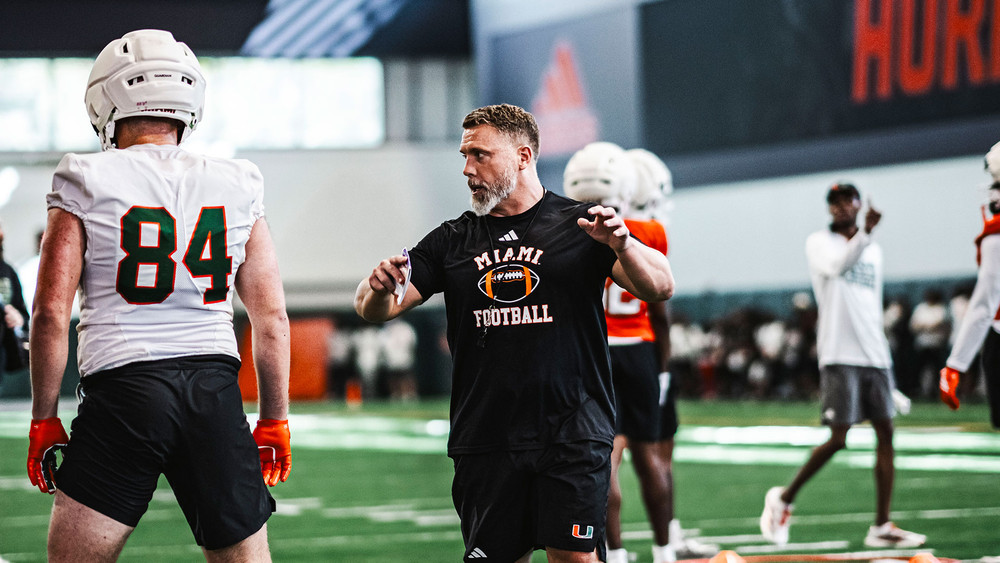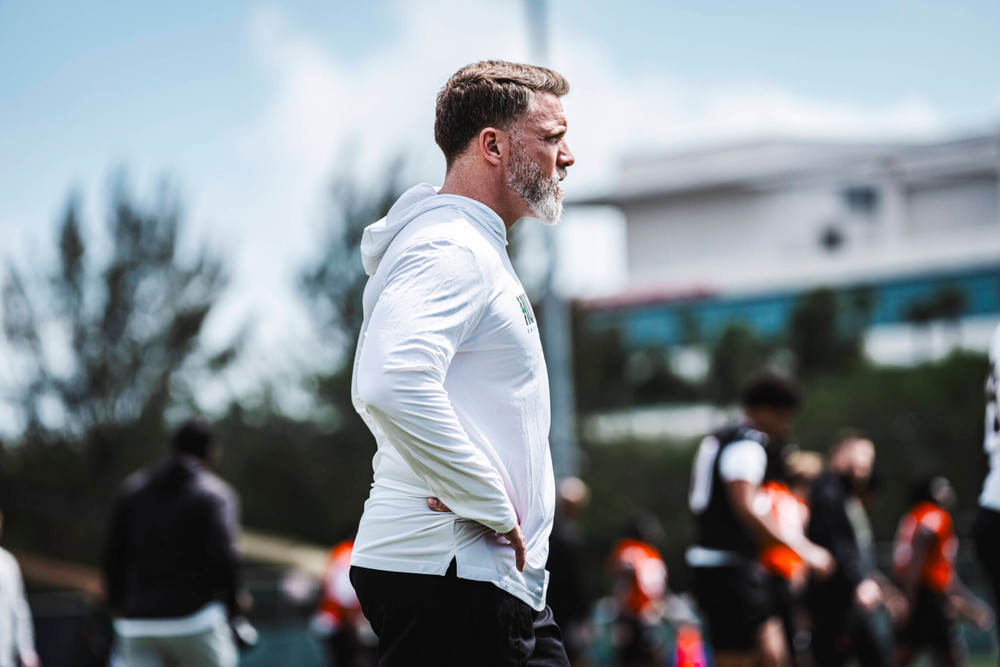


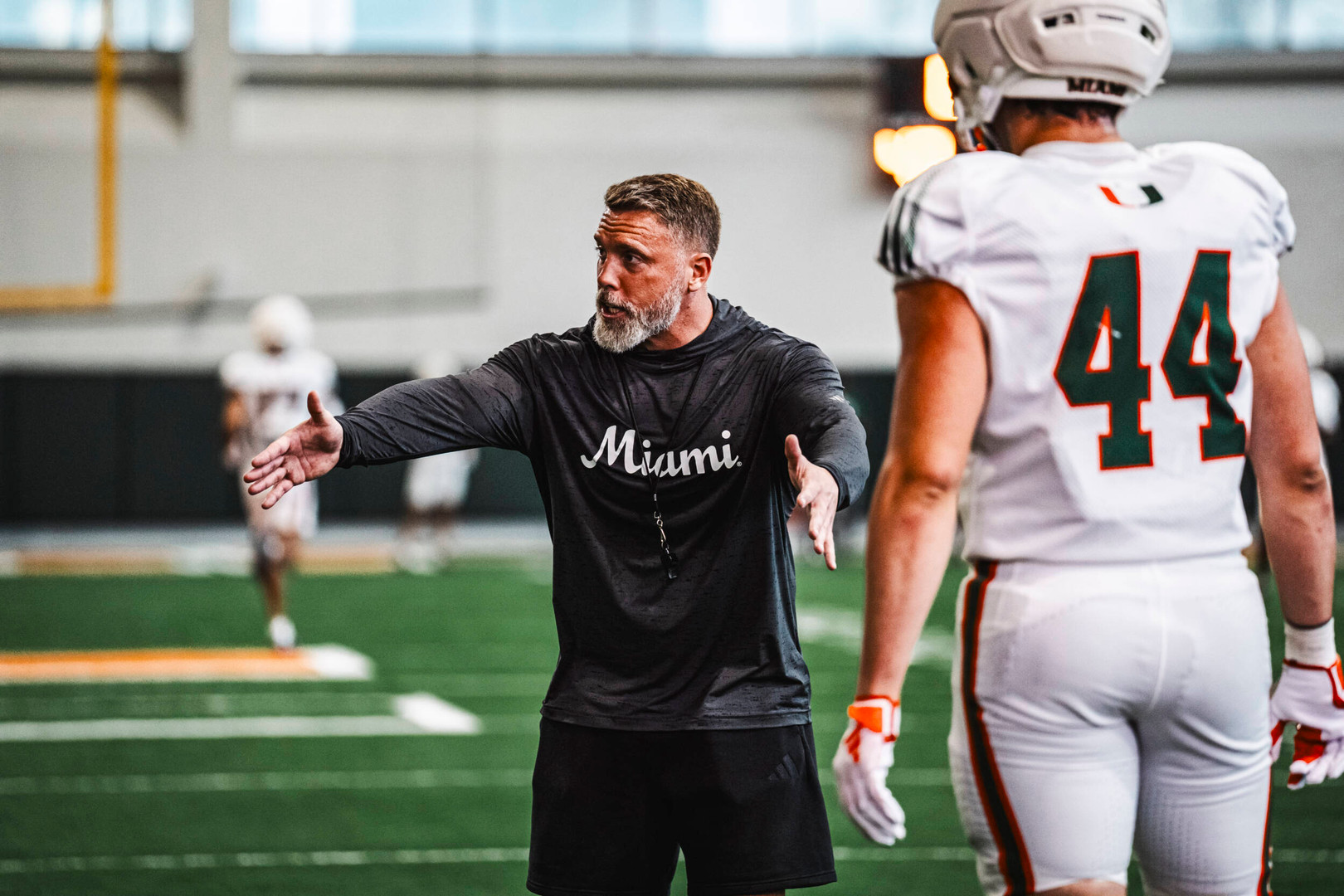
Called to Serve, Called to Coach
CORAL GABLES, Fla. – Mike Viti still remembers the impact that dark day had on him.
He was a high schooler when a plane hijacked by terrorists crashed into a Shanksville, Pennsylvania field about 200 miles away from his hometown of Berwick, Pennsylvania.
Earlier that same day, two other hijacked planes had crashed into the World Trade Center in New York City. Another had slammed into the Pentagon in Washington, D.C.
A grieving nation spent days, weeks, months and even years mourning the 2,977 Americans killed on September 11, 2001, and Viti, who at the time was playing high school football and starting to think about his future, felt called to action during a visit to West Point.
There was an undeniable sense of purpose on the campus. He felt deep admiration and respect for the cadets he met there. And though he admits there were some fears and some hesitations, they were overridden by inspiration and duty.
Viti decided West Point was where he’d continue his football career, knowing full well the commitment that awaited him after his days as a fullback and a cadet at Army ended.
“I was not going to start my adult life with a weak decision,” said Viti, who earlier this year joined the Miami football staff as the Hurricanes’ new tight ends coach. “That was inspiration for me. But I felt a sense of duty. I felt a sense of service to the nation and now I got to combine that with an elite education and a place that trains leaders. That was really important. I thought the morals and ethics and core values of West Point really aligned with the person I aspired to be.
“And it put me on a path. Going to West Point was the second-greatest decision in my life, one that forever projected and set the trajectory of my coaching and leading style and just what I’ve done with my life.”
And Viti, there’s no doubt, has done plenty with his life.
At Army, he was a fullback and team captain for the Black Knights, totaling 91 carries, 306 yards and three touchdowns, while catching 30 passes for 198 yards in 31 career games.
He was a four-year varsity letter award winner and a Regimental Commander.
After graduation, he was commissioned as a second lieutenant in the U.S. Army and was stationed in both Oklahoma and Colorado. He was later deployed as a platoon leader to Afghanistan as part of Operation Enduring Freedom, an experience Viti described as “the single most honorable year of my life.”
“To serve with America’s best [and] to take care of people who can’t necessarily protect themselves was a great responsibility,” Viti said. “And that’s really where I felt everything in my life – whether it was through academics, classical academic settings, military vignettes, and certainly sport, which I think is the ultimate proving ground for leadership regardless of the industry – it all came to fruition.
“As a 23, 24-year-old, life gets real really fast and you realize the importance of preparation. You realize the importance of decision-making, emotional control, leadership, all those things come to life every single moment of every day. … I still have very serious connections with the men and women – my brothers and sisters in arms – who I served with and that’s something that I try to carry into a room, and I try to carry with me. … To me, that’s always going to be a part of me.”
Viti, who was stationed in the Arghandab River Valley – a Taliban stronghold at the time in 2010 – earned a Bronze Star and a Combat Action Badge for his service and eventually retired from the military as a Captain.
But his connection to America’s service members – and to the Army – endured.
After his retirement, Viti wanted to find a way to give back to the military. He researched non-profits that worked with service members and saw good work happening all over the country.
Still, there was one group in particular he believed needed more support and recognition than it seemed to be getting and it was the group he believed had given the most: America’s Gold Star Families.
And so, in 2014, Viti embarked on a cross-country trek where he walked one kilometer for every U.S. service member killed in action during the global war on terror.
For 232 days, he walked. He covered 7,100 kilometers – 4,400 miles – with stops throughout to meet with Gold Star Families.
His journey began in April in DuPont, Washington and ended eight months later in December at the Army-Navy Football Game in Baltimore.
And along with the conversations he’d have with the Gold Star Families he met along the way, every day Viti wrote the names of the service members he was honoring on an American flag.
By the time he made it to Baltimore and M&T Bank Stadium, he’d filled 14 flags with names.
His journey was widely covered in the media, putting a spotlight not only on Viti, but on the families he spoke with and their needs.
That, ultimately, was why Viti walked.
“For me, number one, was to honor my heroes, those who paid the ultimate sacrifice and two, to connect with Gold Star Families. And I thought what better way to connect with Gold Star families then by walking a kilometer for every service member who lost their life in the global war on terror, going through their hometowns and meeting the people who knew them prior to being service members and just listening,” Viti said. “Along the way, I was fortunate to meet 64 Gold Star Families who really told their story and provided inspiration to honor our Gold Star Families forever. … I think service impacts us all differently and for me, that community was a community I wanted to give time and energy to and forever let them know as a born-again civilian and citizen that I’m forever indebted to their sacrifice.”


His walk and the families he met on the way inspired Viti to help found the Legacies Alive Foundation, a non-profit whose mission is to provide support to Gold Star Families and bring awareness to their sacrifices.
And though his collegiate coaching career started soon after his walk ended, Viti and his wife, Laura, remain on the foundation’s board and continue working to make a difference for Gold Star Families across the country.
“We’ll always remember our heroes,” Viti said.
After his service and walk across the country, Viti returned to his alma mater’s football program in 2015 as Army’s Director of High School and Alumni Relations. A year later, he joined the coaching staff and began mentoring fullbacks.
For a decade, Viti worked with Army’s offense, working with a variety of position groups. Before coming to Miami, he served as Army’s associate head coach and offensive line coach and in 2024, the Black Knights line was honored with the Joe Moore Award as the nation’s top unit.
That season, Army led the nation with a total of 4,207 rushing yards. The Black Knights also led the nation with an average of 300.5 yards per game. Last year, Army was still a top-five offense when it came to running the ball, averaging 254.0 yards per game.
For Viti, coaching at his alma mater was special. But when the opportunity presented itself to join the staff at Miami, he was intrigued.
It wasn’t just the Hurricanes’ success last season that caught his attention. It was the culture and the way Miami operated under head coach Mario Cristobal that captured Viti’s imagination.
“I was at a point in my life, in my career where you’re looking to grow. I think that’s the professional appetite of growth and I looked at an organization that was doing it at the highest level, is committed to excellence, is committed to standards, is committed to a brand of football that I’m very familiar with and then there’s Coach Cristobal and the culture he’s created,” Viti said. “Knowing what it’s like to coach at your alma mater, from a different lens and a different level and having aspirations to one day potentially become that, who better to learn from? Who better to learn from, [than] watching somebody who understands the culture at a place he calls home and an alma mater that he has immense pride in? Once I met Coach Cristobal and I met the people [here] and I saw the silver cord of unity, toughness, discipline, physicality, and professionalism, those things stood out and it was just opportunity met timing. Those were the focal points for me.”
And it didn’t take long for Miami’s tight ends group to make an impression once Viti arrived in Coral Gables and got to work on Greentree.
Veteran Elija Lofton saw action in 15 of Miami’s 16 games last season, with four starts. He finished fourth on the team with 23 catches and 218 yards. Joining him in the tight ends room are sophomore Luka Gilbert, redshirt junior Jackson Carver, redshirt senior Jack Nickel and highly touted freshmen Israel Briggs and Gavin Mueller among others.
All have different skill sets and it’s a group Viti believes has the potential to grow into a difference-making unit for the Hurricanes.
“I love the ceiling of the room. I love the development side of it. To me, that’s where I feel I’m talented. But I look at the guys and they’re just as hungry for that,” Viti said. “I look at the room, and we have maybe the most room to grow on the entire team and I’m excited about that. I look at some of the young guys and the youth there like, ‘Hey, we’re starting this journey together.’ And then other guys where I can bring a new skillset into their toolbox.”
And as much of an impact as the Hurricanes have already made on him, there’s no doubt Viti’s made an impact on Miami’s staff, including his new head coach.
“He’s exactly what we thought. Relentless, intense energy and he’s an animal in a good way,” Cristobal said. “High-level teacher, tremendous aptitude, capacity, progression, really detailed, hard-worker, early mornings, late nights, super-high care factor. And you know his history. He’s done things in life that a lot of us can never fathom. I can’t. Certainly, always appreciate him for his service. So, he’s been very impactful in the short time that he’s been here.”
Now, as the Hurricanes continue moving closer to the start of preseason camp and their Sept. 4 season opener at Stanford, Viti’s goal is to continue teaching Miami’s tight ends and ensuring they’re a vital part of the Hurricanes’ offense moving forward.
And he hopes that as he shares the experiences he’s had with his unit and beyond, that he can also help the Hurricanes continue growing, on and off the field.
“I hope my experiences can help drive the culture. … It’s like what were the margins or what are the margins moving forward, so I can sit there and help leaders, help players and be predictive in that,” Viti said. “That’s where I’m excited to add value, because I come from a background where it’s all about development. It’s all about problem solving. It’s all about forecasting problems before they happen and having solutions ready. That’s what I’m looking forward to.”