


Happiness Over Perfection
by: Bella Armstrong
There’s a sacredness to diving.
The contact when the body hits the water. The way the world quiets when you take your place on the board. How the sun rises and sets over the reflective ripples of the pool. The languid stillness squared in your shoulders as you rotate in the air.
There are rituals here. The climb. The breath. The quiet before gravity takes over.
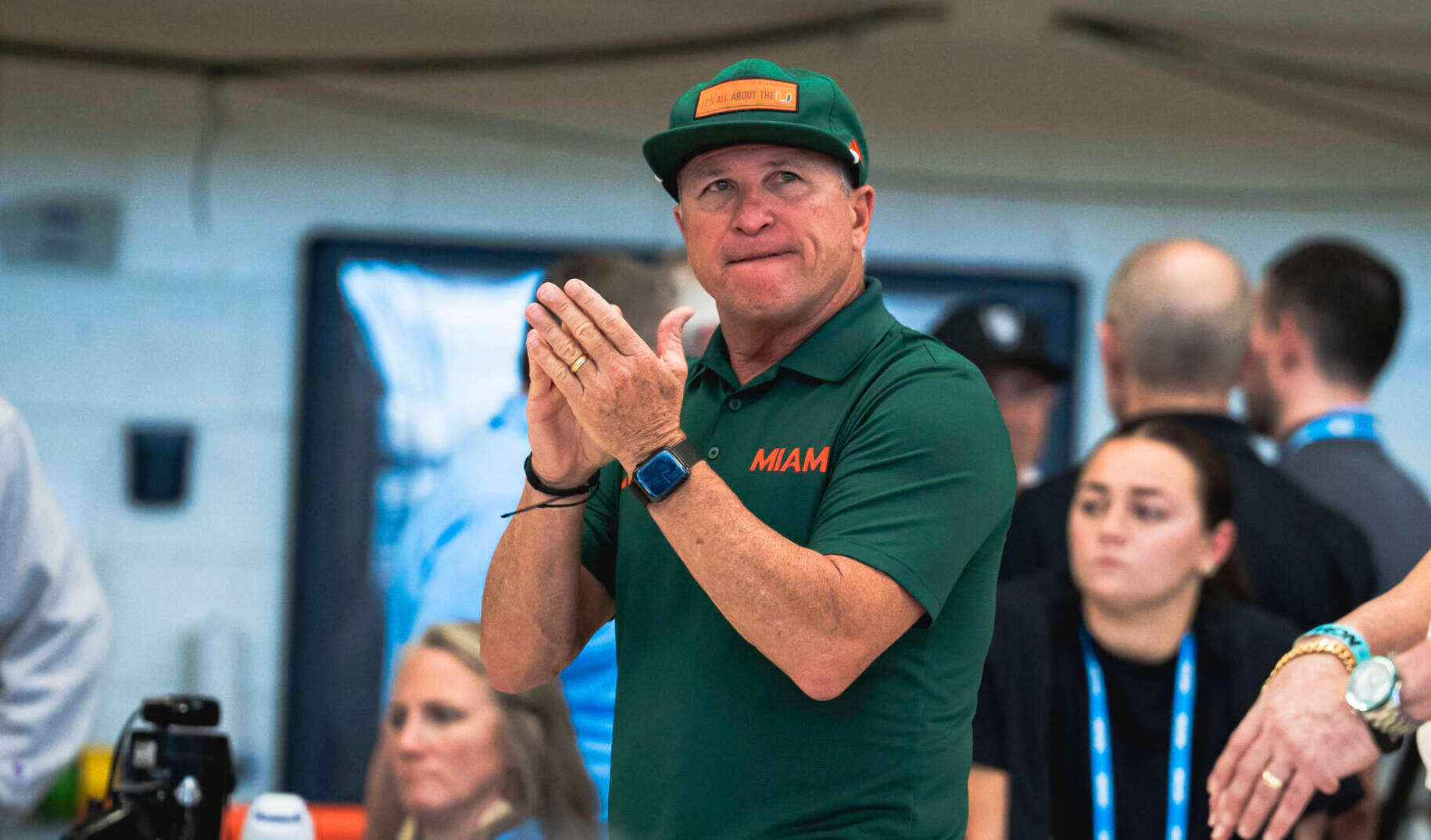
But the space that exists between elite performance and the raw simplicity of human joy may be the most sacred of all. And to protect that balance, University of Miami diving coach Dario di Fazio preaches positivity.
“I demand happiness,” di Fazio said. “Happiness and hard work.”
It sounds simple. Almost unserious. But in a sport like diving, where the margin for error is razor-thin and the consequences are immediate, happiness becomes discipline.
A choice.
A skill.
“Most times when you’re training high-level athletes, there’s a lot of pressure that a lot of these kids put on themselves,” he explained. “And I think when you’re training in that way, you miss how fun really the sport is.”

Photo by Sofiia Briantseva
His office is neat, tidy, and bare. A grey Adidas backpack with his name tagged on the zipper from the ACC Swim & Dive Championships sits in the corner, but few personal items take up residence in the space — like he works out of it when he has to but refuses to live in it.
The real work happens at the pool.
He watches quietly from the deck, arms crossed, stepping in only when something feels off.
Humidity clings to the air. Chlorine lingers. The sharp echo of feet on wet tile cuts through the space as divers move through their routines. Stretch, climb, jump — repeat. There’s no hiding here. No blending into a system. Every dive is an exposure. Divers are stripped down to a single moment and judged by it.
“It’s very unforgiving. You could be practicing a dive 5,000 times, and you have one chance—and one chance only—to do that dive at a certain moment. There’s no way you can repeat it,” di Fazio said, his hands moving as if sketching the moment in the air.
Because like his divers, Coach di Fazio has lived in the pressure.
Long before he became a coach, di Fazio was a diver himself. Originally from Venezuela, he competed under its banner at two Olympics, the Pan American Games, and was crowned a Venezuelan national champion an astonishing 32 times. He understands the sport not just technically, but viscerally — the hesitation before takeoff, the split-second decisions made midair, the way one small doubt can unravel an entire dive.
“I wish I knew when I was a diver all the things I know now as a coach,” he said. “I think I would have definitely been a better diver.”

Photo by Sofiia Briantseva
Di Fazio knows there are no teammates to absorb a mistake. No clock to run out. It’s just his divers, the board and the water waiting for them, unforgivingly, below.
And then he watches them do it again.
“You need to be a student of your sport,” he said. “You need to understand what it is that we’re really trying to do.”
Everything — from the angle of your hips to the timing of your tuck to the way your hands slice through the surface — is repeated until it becomes more than muscle memory. It becomes instinct.
“It’s an extremely difficult sport to learn. It needs a lot of preparation, a lot of dedication,” he said.
Then he smiles.
“It’s a beautiful sport.”
At this level, diving can feel all-consuming. But even here, there’s a balance that can’t be sacrificed.
“We want them to be the best divers they can be, but we want them to be the best people they can be,” di Fazio said. “That’s the most important thing.”
For Max Flory — an All-American diver, NCAA champion and Olympic hopeful — Coach di Fazio’s philosophy didn’t just refine his technique. It reshaped his career.
Flory was a platform diver for most of his career, drawn to the height and adrenaline. But Coach di Fazio saw something in him that he hadn’t yet recognized in himself.
“He told me, ‘You’re a 3-meter diver,’ and I didn’t know what he was seeing,” Flory said. “I had to trust him.”
That trust changed everything. In 2025, Flory became the USA Diving champion in the men’s 3-meter springboard. Now a hopeful member of the U.S. national team, he’s preparing for international competition ahead of the 2028 Summer Olympics in Los Angeles.
But it’s not just the medals that endure.
“Say a dive didn’t go well,” Flory said. “He would tell you to refocus and reframe. He told us to look at things differently.”
Not to ignore mistakes. Not to excuse them — but to understand them without carrying them into the next attempt.
“He’s very supportive,” Flory said. “He doesn’t let you spiral.”

Because in diving, the ladder is always waiting. Another climb. Another breath. Another fall.
Another chance to get it exactly right—or not.
Olympic silver medalist Sam Dorman knows that cycle well. He trained under di Fazio during his time at Miami.
“Dario was always so positive,” Dorman explained. “He and Randy are the best there is.”
Randy Abelman led the program for 35 years before retiring in 2025. His longtime assistant, di Fazio, then stepped into the role. The lineage matters. Philosophy, like technique, is passed down through generations and instilled in new blood.
“I owe them a lot,” Dorman said.
Though Dorman’s competitive career ended shortly after his Olympic debut, what he learned under di Fazio followed him beyond the pool — the structure, the resilience, the ability to separate outcome from identity.
That distinction — the understanding that you are more than your last performance — is at the core of everything di Fazio teaches.
Ironically, it’s not even something he had planned to teach.
After his competitive career, coaching wasn’t part of the plan. But like most things in his life, diving pulled him back. What started as an opportunity became a calling — one that brought him to Miami and into the lives of athletes like Flory and Dorman.
“You have the power of making someone’s day or destroying someone’s day with your comments,” he said. “I’d rather try to make the person’s day.”
That care extends beyond the pool.
At team cookouts and potlucks, structure gives way to something softer. Divers trade their suits for street clothes and bring pieces of home to share. The pool may be their temple, but di Fazio’s backyard becomes their refuge.
He mans the grill. Someone else brings dessert. His kids weave between athletes who, hours earlier, were chasing perfection. Music hums in the background — until it gets turned up.
And then, inevitably, he steps in.
He starts counting under his breath. Demonstrating the steps. Clapping out a rhythm. Encouraging hesitant freshmen into motion.
They spin once. Twice. They laugh when they miss a beat.
Coach di Fazio teaches his divers how to salsa.
Not perfectly. Not competitively. Just enough to feel it.
For a moment, there are no scores. No judges. No pressure. Just a group of athletes learning how to exist inside their bodies without the expectation of getting it exactly right. It’s a different kind of discipline and a different kind of freedom.
He calls them a family. Then he shrugs, a grin breaking through.
“But I’m the best dancer, of course,” he laughs.
He isn’t keeping score, though. Not really.
Because in a sport that measures everything numerically — angles, entries, scores — that’s something he refuses to quantify.
Not everything sacred is meant to be judged. And you can’t put a score on what Coach di Fazio does.