


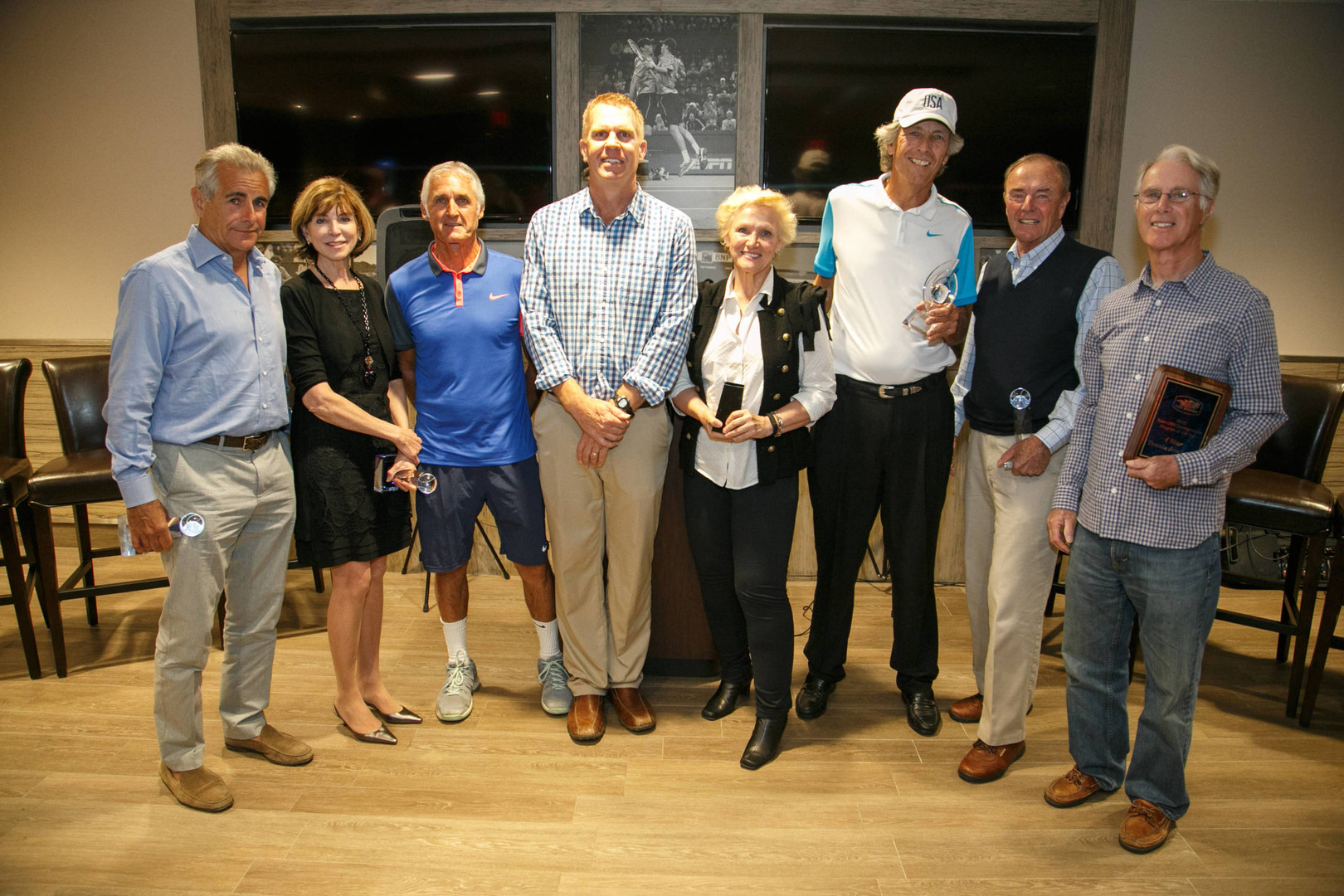
Segura Honored as Team USA Coaching Legend
WHITE PLAINS, N.Y. – Former University of Miami Hurricane and renowned tennis coach Pancho Segura was honored as a Team USA Coaching Legend at the third annual Team USA Coaching Awards reception held Sunday at the ASICS Easter Bowl junior tournament at the Indian Wells Tennis Garden in Indian Wells, Calif.
Renowned for his understanding of the game, Francisco “Pancho” Segura, 94, is perhaps best known as the coach who helped groom Jimmy Connors into the world’s best player in the 1970s. Segura overcame his modest upbringing in his native Ecuador to win three straight NCAA singles titles at the University of Miami (1943-45) and become the Co-World No. 1 in 1950 and world No. 1 in 1953. He began coaching in the late 1960s, first out of the Beverly Hills Tennis Club and later at the La Costa Resort in San Diego, counting Connors, Stan Smith, Michael Chang and a myriad of Hollywood stars among his students. He was inducted into the International Tennis Hall of Fame in 1984.
“Pancho Segura is the embodiment of hard work and perseverance,” said USTA Player Development General Manager Martin Blackman. “The adversity he overcame to become a champion and a coach of champions as one of the smartest minds in tennis is one of the game’s greatest inspirations. He was a great player, a great entertainer and remains a great coach and mentor to many. Pancho was part of the barnstorming movement in the 1950s that ushered in professional tennis, and the professional game owes him and his fellow pioneers a debt that can never be fully repaid.”
Born on June 20, 1921 in Guayaquil, Ecuador, Francisco “Pancho” Segura suffered from rickets as a youth. Restricted from playing some sports, Segura took to tennis and developed what the late Jack Kramer would once call “the single greatest shot in the history of tennis” – a two-handed forehand.
Segura would enter the University of Miami on a tennis scholarship while Gardnar Mulloy was at the helm of the program. On November 4, 1943, Segura, the fourth ranking amateur in the United States at the time, met the world’s No. 1 professional tennis player J. Donald Budge in an exhibition match. After dropping the first set 3-6, Segura came back to dominate the next two sets (6-0, 6-1) to win the match.
As a Hurricane, he won three straight NCAA singles championships from 1943-45. Segura also won the U.S. Indoor Title of 1946 and the U.S. Clay Court of 1944. He was a U.S. semifinalist from 1942-45 and a member of the U.S. Top Ten six times, No. 3 in 1943, 1944 and 1945.
In 1950, three years after turning pro, Segura won the U.S. Pro Tennis Championship singles title over Frank Kovacs. In 1951 and 1952, Segura defeated Pancho Gonzalez claiming his second and third consecutive singles titles. In 1950 and 1952, Segura was the World Co-No. 1 player.
In addition to his singles titles, Segura won the U.S. Pro Tennis Championship doubles title with Kramer in 1948 and 1955 and the 1954 and 1958 titles with Gonzalez.
In 1968, Segura partnered with Alex Olmedo and entered the doubles of the first open Wimbledon. In the second round they won the longest doubles match of Wimbeldon’s open era, 94 games, over Abe Segal and Gordon Forbes (32-30, 5-7, 6-4, 6-4). The 62-game set was the longest ever.
Due to his astonishing career, Segura would be elected into three Halls of Fame. The University of Miami’s hall in 1970, the International Tennis’ hall in 1984, and the USTPA’s hall in 2012.
###
The USTA is the national governing body for the sport of tennis in the U.S. and the leader in promoting and developing the growth of tennis at every level — from local communities to the highest level of the professional game. A not-for-profit organization with more than 715,000 members, it invests 100% of its proceeds in growing the game. It owns and operates the US Open, the highest-attended annual sporting event in the world, and launched the Emirates Airline US Open Series, linking seven summer tournaments to the US Open. In addition, it owns approximately 90 Pro Circuit events throughout the U.S. and selects the teams for the Davis Cup, Fed Cup, Olympic and Paralympic Games. The USTA’s philanthropic entity, the USTA Foundation, provides grants and scholarships and helps under-resourced youth and individuals with disabilities, and supports wounded, ill and injured service members, veterans and their families. For more information on the USTA, log on to usta.com, “like” the official Facebook page, facebook.com/usta, or follow @usta on Twitter.